

Returning to Sport After Knee Surgery
For any athlete, the journey back to the field, court, or track after knee surgery can feel like a marathon. Even if the desire to play again is strong, the path to a safe and triumphant return requires patience, diligence, and expert guidance. Simply waiting for a certain number of months to pass is not enough. A structured, criteria-based approach is essential to minimise the risk of re-injury and ensure you come back stronger than before.
The return to sport is highly variable and requires more than regaining function. The biological process of healing occurs in a reproducible and predictable fashion. Undoing the psychological damage of ingrained instability, however, is highly variable. Most people return to sport after knee surgery once strength, stability, and functional testing show the knee can tolerate load and once the athlete regains the ability to subconsciously trust the knee. Healing of a reconstructed ACL often requires 9–12 months for full ligamentization and remodelling, while meniscus healing is dependent on the size and location of the tear and can take 3-6 months. A surgeon or physiotherapist must confirm readiness before resuming sport.
Our blog provides a broad roadmap for returning to sport after common knee surgeries, such as ACL reconstruction and meniscus procedures. It outlines expected timelines, critical rehabilitation phases, and the key benchmarks you must meet before you are cleared to play.
Why Returning to Sport Requires a Structured Approach
A surgical procedure is only the first step in correcting a knee injury. The comprehensive rehabilitation that follows is what truly determines your long-term outcome. Rushing back to sport without allowing proper physical and psychological healing and rebuilding strength is one of the biggest mistakes an athlete can make.
The importance of a structured approach comes down to three key factors:
- Tissue Healing: After surgery, whether it’s a ligament graft or a repaired meniscus, the tissue needs time to heal and integrate with your body. This biological process cannot be rushed. Overloading the knee too early can compromise the repair and lead to failure.
- Re-injury Risks: The risk of re-injuring a reconstructed ACL or tearing another part of the knee is highest in the first year after surgery. A premature return to sport, before the knee has regained adequate strength and neuromuscular control, dramatically increases this risk.
- Procedural Differences: Not all knee surgeries are the same. Each procedure has a unique healing timeline and requires a tailored rehabilitation plan based on the function of the damaged knee structure.
Expected Timeframes for Returning to Sport
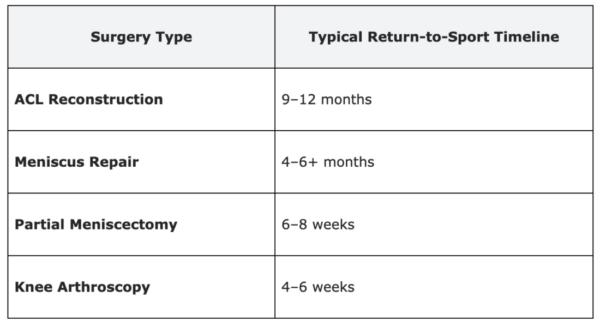
While every patient is different, evidence-based protocols provide general timelines for returning to sport. These are not deadlines but guides. Progress is determined by meeting specific criteria at each stage, not by simply marking days off a calendar.
ACL Reconstruction
This is one of the longest recovery journeys in sports medicine.
- Running: Typically begins around 3-4 months post-surgery, once strength and control are sufficient.
- Change of Direction: Agility drills and sport-specific movements are introduced between 6–9 months.
- Full Contact Sport: A return to competitive, full-contact sport is generally not recommended before 9–12 months.
- A return to peak performance actually takes 2 seasons following reconstruction.
Meniscus Repair
When the meniscus is stitched back together, it needs time to heal.
- Running: Usually permitted after 3 months.
- Pivoting Sports: A return to sports involving cutting and twisting is often possible around 4–6 months.
- Contact Sport: May require 6 months or more, depending on the size and location of the repair.
Partial Meniscectomy
When a small, damaged piece of the meniscus is removed, recovery is much faster.
- Running: Can often resume within 3–6 weeks.
- Sport: A full return is typically possible within 6–8 weeks.
Knee Arthroscopy
For a diagnostic or minor “clean-up” procedure.
- Sport: Depending on the findings and the actions taken, a return to sport can be as quick as 4–6 weeks.
Key Criteria Before Returning to Sport
Time is only one factor. Before you can be cleared for sport, you must pass a battery of tests that demonstrate your knee is ready for the demands of competition.
Strength Benchmarks
Your surgically repaired leg must be just as strong as your uninjured leg.
- Quadriceps & Hamstring Strength: Using dynamometers, we measure the strength of your key muscle groups. Your operated leg should have at least 90% of the strength of your other leg. Quadriceps weakness is a major predictor of poor outcomes.
- Single-Leg Control: You must be able to perform movements such as a single-leg squat and a single-leg deadlift with excellent form, demonstrating stability and control.
Functional Testing
These tests simulate the movements you will perform in your sport.
- Hop Test Series: This includes a series of single-leg hops for distance and height. Your performance on the operated leg should be at least 90% of your performance on the uninjured leg. This shows power and the ability to absorb impact.
- Change-of-Direction Testing: Drills that involve cutting, pivoting, and decelerating are used to assess your knee’s stability during dynamic movements.
- Sport-Specific Drills: You will progress to drills that mimic the exact demands of your sport, ensuring your body and mind are prepared.
Psychological Readiness
The mental aspect of recovery is just as important as the physical one.
- Confidence on Landing and Pivoting: You must trust your knee again. Any hesitation can lead to altered movement patterns and increase the risk of re-injury.
- Fear of Re-injury: It is normal to feel some apprehension. However, a high level of fear can delay your return and affect your performance. Sports psychology can be a valuable tool for rebuilding confidence.
- Neuroplasticity training: You must trust your knee again. Any hesitation can lead to altered movement patterns and increase the risk of re-injury. It is normal to feel some apprehension. However, a high level of fear can delay your return and affect your performance.
Rehabilitation Phases
A successful recovery from knee surgery follows a phased approach, with clear goals at each stage.
Early Phase (Weeks 0–6)
The initial focus is on protecting the surgical site and managing post-operative symptoms.
- Pain and Swelling Management: Using ice, elevation, and appropriate medication.
- Range-of-Motion Goals: Gently restoring the knee’s ability to bend and straighten is a top priority.
Strength & Conditioning Phase (Weeks 6 to Month 4)
This is where you build the foundation for your return to sport.
- Glute and Hamstring Strength: These muscles are crucial for supporting the knee and protecting the ACL.
- Neuromuscular Control: Retraining the nerves and muscles to work together to control the joint. This involves extensive balance and stability exercises.
Running & Agility Progression (Months 3–9)
Once your strength base is solid, you can start re-introducing dynamic movements.
- Straight-Line Running: Beginning with a walk-jog program and gradually increasing intensity and duration.
- Acceleration, Deceleration, and Cutting: These skills are broken down and practised in a controlled environment before being combined.
Return-to-Play Phase (Months 9+)
The final stage involves a gradual reintegration into your sport.
- Sport-Specific Training: Participating in non-contact drills with your team.
- Contact Drills: Progressing to controlled contact scenarios to prepare for the unpredictability of a game.
- Final Clearance: Your surgeon and physiotherapist will conduct the final round of functional testing to give you the green light.
Common Setbacks and How to Manage Them
The road to recovery is not always a straight line. Setbacks can and do happen.
- Persistent Swelling: This indicates the knee is being overloaded. It’s important to pull back on activity and let it settle.
- Loss of Quadriceps Strength: Difficulty regaining quad muscle can slow progress. Your physiotherapy program must aggressively target this.
- Hesitation with Pivoting: If you don’t feel confident in the knee, you need more time spent on neuromuscular control drills.
- Residual Joint Pain: Pain is a signal to modify your activity. It’s important to communicate this to your therapist to adjust your program.
Never push through significant pain. If symptoms persist, it warrants a reassessment to ensure the knee is healing correctly.
Risk of Re-Injury & How to Reduce It
The most effective way to reduce your risk of re-injury is not to rush back. Studies have shown that for each month an athlete delays their return to sport up to 9 months post-ACL surgery, the re-injury rate is significantly reduced.
- Why Early Return Increases Re-Tear Rates: A premature return means the ligament graft hasn’t fully matured, and the muscular system lacks the strength and coordination to protect it.
- Importance of Structured Testing: Objective, data-driven testing removes the guesswork. Passing functional and strength tests is the best insurance policy against re-injury.
- The Role of Physiotherapy: Your relationship with your physiotherapist doesn’t end when you return to play. Continuing with a maintenance strength program is vital for long-term knee health.
When to See a Knee Specialist
While a physiotherapist will guide your rehabilitation, you should consult your orthopaedic surgeon if you experience any of the following:
- Pain that is not improving or worsening.
- Sensations of knee instability, giving way, or shifting.
- Mechanical symptoms like locking or catching.
- A failure to progress through your rehab milestones as expected.
An expert assessment can identify any issues and ensure you are on the right track.
Book a Consultation
If you’re preparing to return to sport after knee surgery, an individualised assessment provides the safest path back to activity. Dr Dan Cohen consults in Bondi Junction and Kogarah, offering comprehensive care for ACL, meniscus and sports-related knee injuries. An accurate plan based on your specific surgery and goals is one of the most important steps in your recovery.