

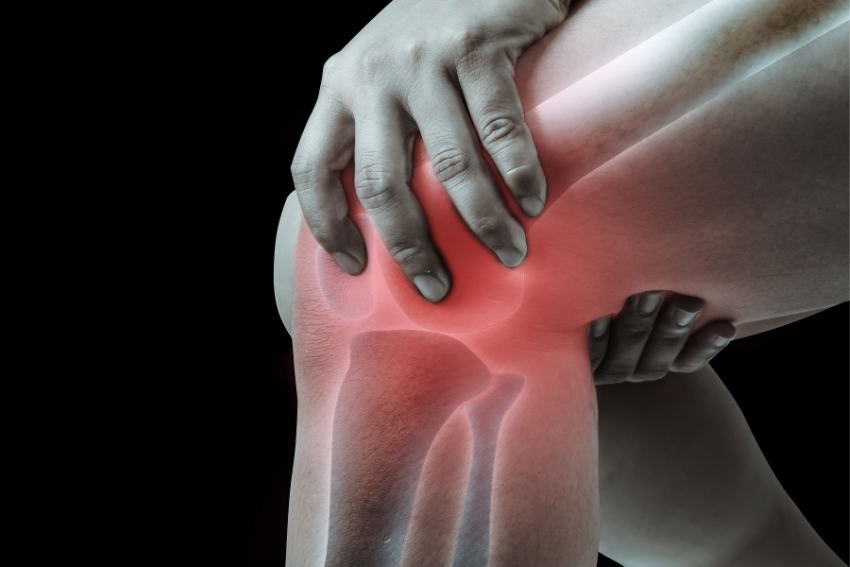
What Is a Baker’s Cyst? Understanding the Lump Behind Your Knee
A Baker’s cyst is a fluid-filled swelling that develops at the back of the knee, in the hollow space behind the joint known as the popliteal fossa. It forms when excess synovial (joint lubricating) fluid from an inflamed knee joint accumulates under pressure, the fluid escapes the knee through a 1 way valve, distending a small bursa within the posterior knee capsule.
It’s not a disease in itself; it is a consequence of inflammation and fluid accumulation inside the knee. Understanding what is driving it is the foundation of effective, lasting treatment.
Why Does a Baker’s Cyst Form?
To understand a Baker’s cyst, it helps to know how the knee manages its internal environment.
The inside of the knee is lined by a membrane called the synovium. Under normal conditions, the synovium produces a small, carefully regulated volume of synovial fluid, a viscous substance that lubricates the joint surfaces to allow friction-free movement and delivers nutrients to the articular cartilage. When the knee is irritated or inflamed, the synovium responds by producing more fluid than the joint requires. Pressure within the joint rises.
At the back of the knee, there is a natural communication between the main joint space and a small bursa located between the medial head of the gastrocnemius muscle and the semimembranosus tendon. Under sufficient intra-articular pressure, this excess fluid travels through the opening and pools in the bursa. A one-way valve mechanism means fluid can move from the joint into the cyst but cannot easily return. As long as the underlying joint inflammation continues to drive fluid production, the cyst will persist and often enlarge.
This mechanism has a clinically important implication: the cyst is not generating the problem. It is a downstream consequence of what is happening within the joint.
What Causes a Baker’s Cyst?
In adults, a Baker’s cyst is almost always secondary to an identifiable intra-articular condition. The most common drivers include:
Knee osteoarthritis
The most frequent underlying cause is particularly in adults over 50. As articular cartilage thins and the joint lining becomes chronically inflamed, sustained overproduction of synovial fluid is common. Not only is the amount of fluid increased, but its consistency is less viscous, more watery, making it easier to escape the knee under pressure. Baker’s cysts associated with knee osteoarthritis tend to be persistent and will continue to recur unless the underlying joint condition is managed effectively.
Meniscal tears
Posterior horn tears, in particular, can irritate the synovial membrane and trigger a significant inflammatory response within the knee. Meniscal pathology and Baker’s cysts frequently coexist, and identifying a meniscal tear changes both the investigation and management approach.
Articular cartilage (chondral) lesions
Focal damage to the joint surface, whether from a previous injury or progressive wear, can provoke an ongoing inflammatory response inside the joint.
Inflammatory arthritis
Conditions such as rheumatoid arthritis involve inflammation of the synovial membrane, and the resulting sustained fluid overproduction is a recognised cause of Baker’s cysts in this population.
In adults, the cyst is almost always a signal that something inside the knee warrants proper attention.
Add ligament tears, such as ACL or PCL
Symptoms: What Does a Baker’s Cyst Feel Like?
Baker’s cysts vary considerably in size and presentation. Some patients are entirely unaware they have one until it is identified incidentally on an ultrasound or MRI.
When symptoms are present, they typically include:
- Posterior knee tightness or fullness
- A sense of pressure or congestion at the back of the knee, most noticeable when bending or fully straightening the leg.
- A visible or palpable swelling
- A soft, fluctuant lump at the back of the knee that is often most apparent when standing and may reduce or disappear when the knee is fully extended.
- Discomfort at the extremes of movement
- Both deep knee flexion and full extension can compress or tension the cyst, producing an aching or pulling sensation.
- A sense of restricted movement
Patients may find it difficult to fully bend the knee or notice that the posterior aspect of the knee feels blocked or tight during activity.
Important: Cyst Rupture and DVT
If a Baker’s cyst ruptures, the fluid it contains disperses into the fascial compartments of the calf. This produces sudden onset calf pain, swelling, and bruising that may track downward toward the ankle. This presentation, known as pseudothrombophlebitis syndrome, closely resembles the symptoms of a deep vein thrombosis (DVT).
Any sudden onset of calf pain, swelling, or bruising in a patient with a known or suspected Baker’s cyst must be assessed medically without delay to exclude DVT before attributing the symptoms to a cyst rupture. Do not wait; monitor and seek review promptly.
How Is a Baker’s Cyst Diagnosed?
An experienced clinician can typically suspect a Baker’s cyst from the clinical history and physical examination alone. The posterior location, the soft and compressible nature of the swelling, and the associated knee symptoms are characteristic.
Investigation is used to confirm the finding and, more importantly, to identify the underlying intra-articular pathology driving it.
Xray
Weight-bearing X-ray is the first-line imaging modality. If advanced arthritis is evident, this is most often the cause of the Baker’s Cyst.
Ultrasound
Ultrasound is quick and non-invasive and can help to rule out other causes of posterior calf pain, such as a muscle tear, deep vein thrombosis or vascular issue. US can also be used for guided aspiration or injection if clinically indicated.
MRI
Used when the underlying intra-articular pathology needs detailed characterisation, particularly when a meniscal tear or chondral lesion is suspected. MRI provides the information needed to guide definitive treatment. It is the identification and management of the underlying condition that determines whether the cyst resolves durably or continues to recur.
Why Just Draining It Often Isn’t the Answer
One of the most common questions patients ask is whether the cyst can simply be drained. The short answer is that draining the cyst in isolation, without addressing its underlying cause, is associated with a high rate of recurrence, because the cyst is not generating the problem; the joint inflammation is.
As long as the synovial membrane continues to overproduce fluid, the posterior bursa will refill. Aspirating the cyst without treating the joint is the clinical equivalent of mopping the floor without fixing the leak.
A corticosteroid injection placed into the knee joint, not into the cyst directly, works differently and more effectively. Reducing the inflammatory activity of the synovial membrane reduces the volume of fluid produced within the joint. As intra-articular pressure normalises, the cyst deflates indirectly. This is not a permanent cure; it is a management tool that addresses the inflammatory driver and creates a window for rehabilitation.
Why the Knee Gets Weaker Over Time and Why It Matters
Understanding how a Baker’s cyst fits into the broader pattern of joint degeneration is important, as it explains both why symptoms tend to worsen without treatment and why management needs to address more than just swelling.
When a Baker’s cyst is present, and the posterior knee is tight and uncomfortable, patients instinctively guard the joint. They bend it less, walk less, and avoid activities that cause discomfort. In the short term, this makes sense. Over time, however, it sets in motion a cycle that is difficult to reverse without targeted intervention.
As activity reduces, the muscles surrounding the knee, quadriceps, hamstrings, and the calf musculature weaken progressively from reduced use. These muscles are not merely movers; they are the primary shock absorbers and load distributors of the knee joint. When they weaken, the joint itself must absorb forces that healthy musculature would otherwise share and distribute. This increased joint loading perpetuates the inflammatory response within the knee, driving further fluid production that sustains and often enlarges the cyst.
This is the pain cycle as it applies to the knee, and it is one of the key reasons why early management produces better outcomes than delayed intervention. Managing this cycle effectively requires attention to each stage. Reducing the activities that place the most load on the joint, controlling the inflammation that drives fluid overproduction, and progressively rebuilding the muscular support the knee depends on.
Introducing strengthening exercises before inflammation is adequately managed tends to aggravate rather than help. The sequencing of treatment is as important as the treatment itself.
The Multi-Targeted Approach to Baker’s Cyst
- Step 1: Modify activities that excessively load the joint; this reduces intra-articular pressure and creates a rehabilitation window.
- Step 2: Control the inflammation driving fluid overproduction through medication, physiotherapy, or injection therapy.
- Step 3: Progressively rebuild muscular support around the knee, strengthening the quadriceps and surrounding structures to better support the joint and reduce vulnerability to inflammatory flare-ups.
Treatment Options for Baker’s Cyst
Management is guided by the severity of symptoms and the nature of the underlying condition. For most patients, the approach is staged and conservative before more invasive options are considered.
Conservative management
Activity modification to reduce joint loading, anti-inflammatory medication where appropriate, and physiotherapy to address muscular weakness and movement patterns contributing to joint stress. This is the appropriate starting point for most patients with a recently identified or mildly symptomatic cyst.
Corticosteroid injection into the knee joint
A well-established intervention that targets the synovial inflammation driving fluid overproduction. When effective, intra-articular pressure reduces, and the cyst deflates as a consequence. A joint injection creates a window for rehabilitation; it works best as part of a structured programme, not as a standalone intervention.
Surgical management
Reserved for cases where a structural intra-articular pathology, most commonly a meniscal tear or articular cartilage lesion, is identified as the primary driver and conservative measures have been insufficient.
Addressing the intra-articular cause removes the source of excess fluid, thereby resolving the cyst. Surgical removal of the cyst itself in isolation, without treating the underlying joint, carries a high recurrence rate and is not the recommended approach.
Need to mention Joint replacement surgery for advanced degenerative arthritis
When to Seek a Specialist Assessment
Not every Baker’s cyst requires urgent assessment, but certain presentations should prompt a formal orthopaedic review without delay:
- Sudden onset of calf pain, swelling, or bruising, to exclude deep vein thrombosis
- A cyst that is persistently enlarging or causing significant restriction of knee movement
- Associated knee symptoms, such as instability, locking, or catching, may indicate a structural intra-articular problem
- Posterior knee symptoms that are affecting daily activities, work, or sleep quality
- A cyst that has not responded to a reasonable trial of conservative management
A specialist assessment provides the diagnostic clarity that self-management cannot. It identifies what is driving the cyst, determines whether the underlying condition requires further investigation or intervention, and produces a management plan targeted at the cause rather than the symptom.
A Baker’s cyst is one of the knee’s most consistent early warning signals. It tells you that something inside the joint is producing more inflammation and fluid than the knee can quietly manage, and that without addressing the underlying condition, the inflammation and fluid are unlikely to resolve on their own.
In most cases, the condition driving the cyst is identifiable, treatable, and best managed before significant structural changes develop. The cyst itself is not the problem. What is causing the joint to inflame and overproduce fluid?
For patients in Sydney’s Eastern or Southern Suburbs noticing unexplained posterior knee swelling, tightness, or restricted movement, an assessment with Dr Dan Cohen can help to provide a clear diagnosis and a structured management plan, ensuring that treatment is directed at the cause, not just the consequence.